Among the F1 2026 teams that have managed to stand out, Audi has undoubtedly captured attention by unveiling a surprisingly original single-seater, particularly in the sidepod area.
- An Unexpected Character: Audi’s “Personal” Sidepods
- Vertical vs Horizontal: The Radiator Inlet Revolution
- An “Upper Flow” Philosophy: Audi’s Aerodynamic Vision
- An Extreme Comparison: Who Will Be Right in 2026?
- Watch our full technical breakdown and discover all the details about Audi’s revolutionary design (and much more) in our Race Tech analysis video.
An Unexpected Character: Audi’s “Personal” Sidepods
While many teams appear to be following established aerodynamic trends, Audi has chosen its own path. As highlighted by engineer Riccardo Romanelli, Audi’s sidepod design has emerged as the most significantly different solution seen so far, finally showcasing a distinctive “character” that was missing from the early concepts.
During the initial shakedown, the car featured more “conventional” shapes. However, testing in Bahrain revealed the definitive version, the result of a conceptual overhaul that left observers impressed by its boldness.
Vertical vs Horizontal: The Radiator Inlet Revolution
Two elements stand out in Audi’s design:
Radiator Inlet Orientation:
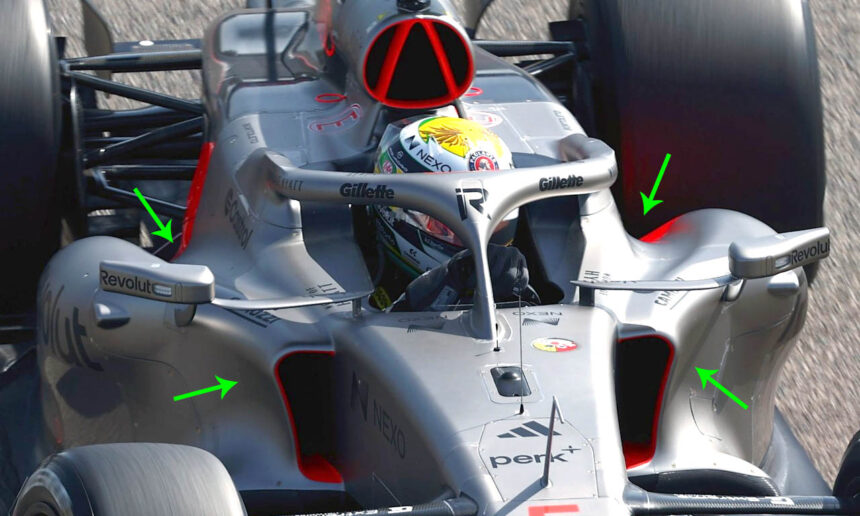
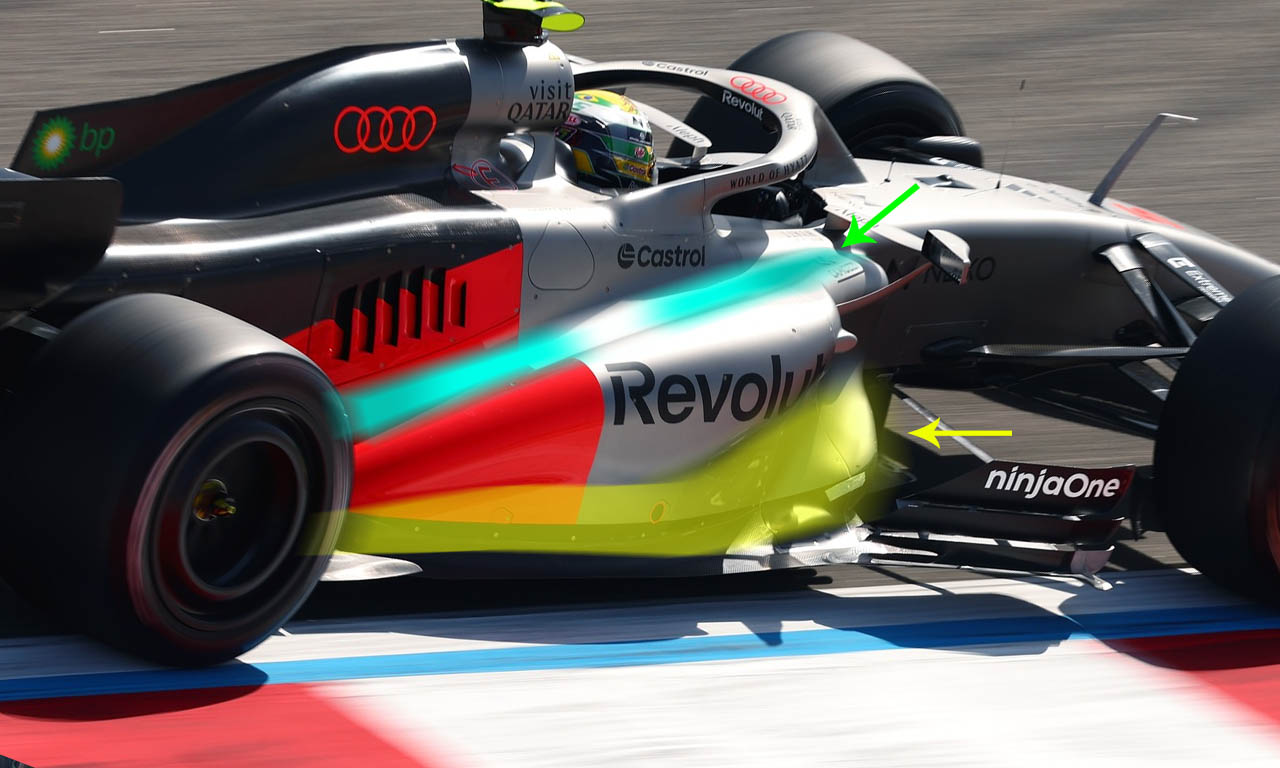
Unlike most teams, which have developed radiator inlets transversely and positioned high on the sidepods, Audi has opted for a vertical layout. This choice, combined with the visible channels and concavities on the upper surface of the sidepods, suggests an innovative approach to airflow feeding.
Descending Profile and Rear Width:
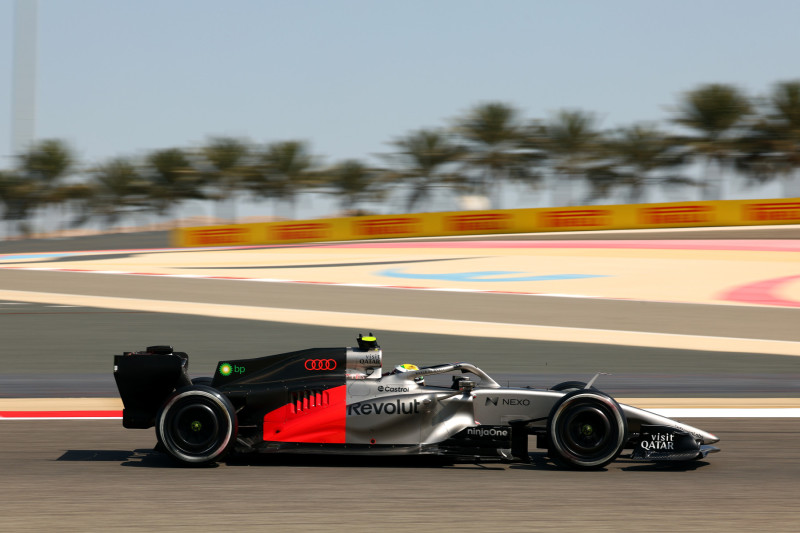
Audi’s sidepod features an extremely downward-sloping profile in side view and considerable width toward the rear. Despite this width, Romanelli does not identify critical flow separation issues that could negatively impact drag at high speed.
An “Upper Flow” Philosophy: Audi’s Aerodynamic Vision
Audi’s concept appears focused on feeding the crucial rear section of the car (the area between the rear wheels) predominantly from airflow traveling over the top of the sidepods and toward the region above the diffuser. This effectively separates the aerodynamic workload occurring around the air scoop and rear wing supports from that of the lower body.
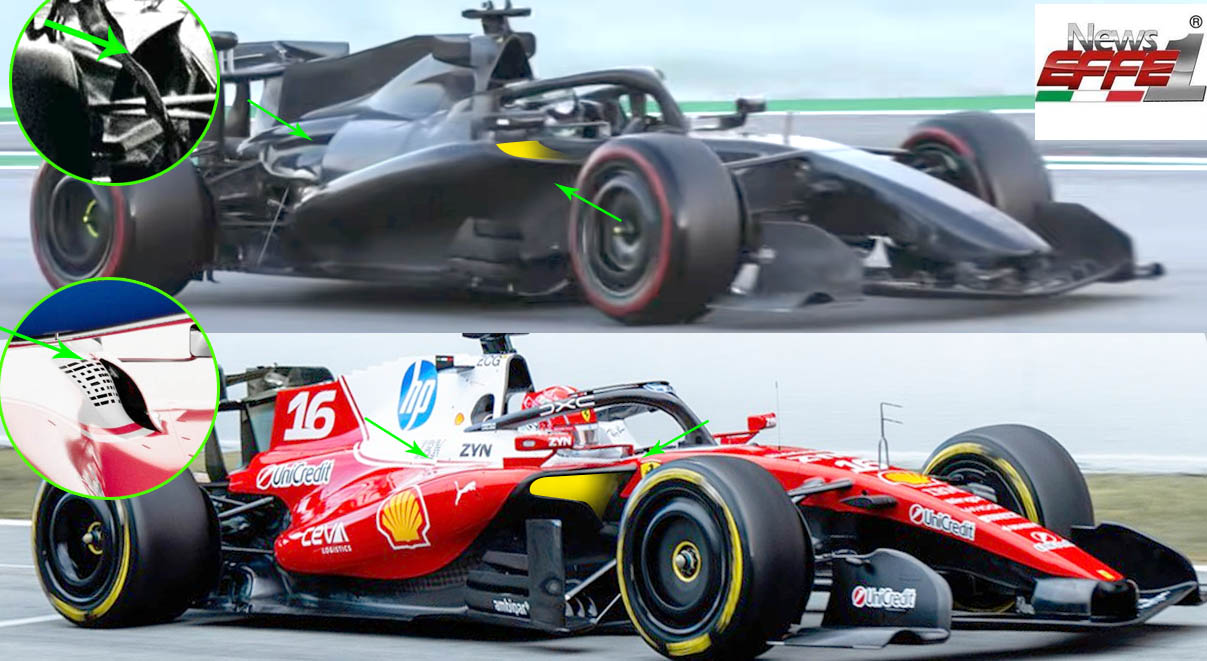
This approach contrasts sharply with the philosophy adopted by Aston Martin, for example, which pushes undercut and lower sidepod airflow management to the extreme in order to maximize front-wheel wake outwash. Audi instead seems to prioritize a different body separation strategy relative to the front wheel and the generation of pressure zones ahead of the radiator inlets.
An Extreme Comparison: Who Will Be Right in 2026?
Audi’s bold deviation from consolidated trends makes the comparison with its rivals even more fascinating. With such markedly different aerodynamic philosophies, it is clear that one direction will ultimately prove more effective than the other.
Engineers are clearly pushing the boundaries, and only track performance and future development will determine which of these extreme solutions will dominate Formula 1 in 2026. One certainty remains: Audi has demonstrated a clear vision and strong character — and that is already an excellent starting point.